
Junior Zoologist Science Fair
Turn your classroom into a living animal museum!
*PILOT PROGRAM AVAILABLE*
Now booking a limited number of schools for the remaining 2025–2026 school year!
The Junior Zoologist Science Fair is a unique classroom program that transforms students into young scientists for the day.
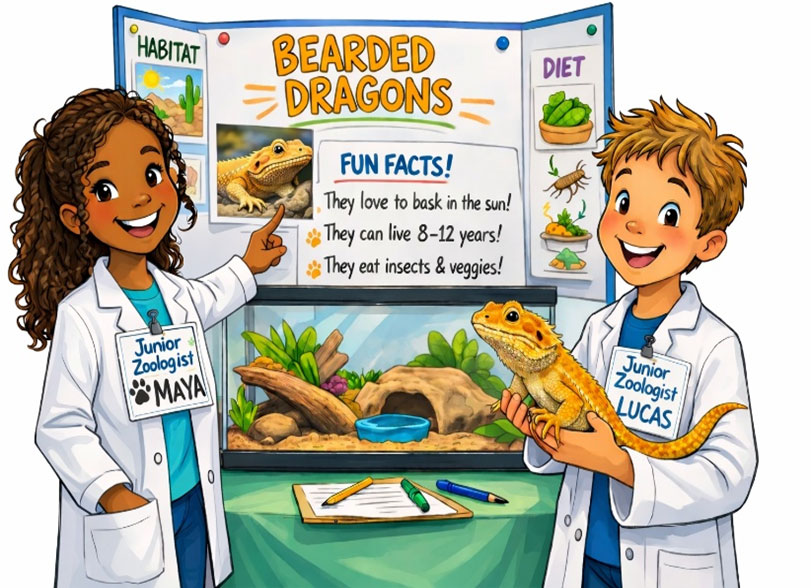
Working in groups of 2-3 students, they research a species from the ZooToYou animal selection list and create their display horizontally on bristol board to accompany the live animal. Coroplast tri-fold boards are supplied for the display exhibits.
On the day of the event, students share their research beside their chosen animal, while visiting classes rotate through the fair, asking questions and exploring the exhibits.
This inquiry-based, experiential learning program builds confidence, scientific curiosity, and communication skills while bringing the wonder of live animals directly into the classroom.
How the Program Works!
Before Fair Day
- Students form up to 12 groups of 2–3, depending on the class size.
- Each group then chooses an animal from the provided species list below.
- The groups then research their chosen animal and prepare their display on a white sheet of bristol board (28″x22″ horizontally) that explains their animal’s habitat, behaviour, adaptations, and other interesting facts. (coroplast tri-fold display boards are supplied on fair day)
- Information sheets and printable images for the chosen species are provided to the teachers to help support the student’s research.
- Teachers send ZooToYou the students’ names and corresponding species choices for their name badges and certificates.
On Fair Day
- The ZooToYou Edzoocator arrives at least one hour prior to the scheduled start time with the selected 10–12 live animals and their secure display habitats and sets up the classroom, library, or gym exhibits accordingly.
- Each group clips their projects to the display stands and gets into their provided lab coats with personalized name badges.
- The students then stand beside the animal they researched and share what they have learned, while visiting classes rotate through the exhibits, asking questions and exploring the animals.
- Each student participates in a photo opportunity with their chosen animal. (interaction level depends on school policies)
- Each student receives a Junior Zoologist certificate and gets to keep their name / species badge.
What Zoo To You Provides
- 10–12 live animals (see animal options below)
- secure locked display terrariums (5-15 gallon tanks)
- coroplast tri-fold display boards (with stands and clips) for each group to display their bristol board on
- classroom, library, or gym setup and constant supervision by a trained ZooToYou Edzoocator
- 34” x 34” tables with tablecloths to display each exhibit
- species information sheets and printable images given ahead to teachers to support student research
- Junior Zoologist lab coats for students to wear during the fair
- take-home certificates and name / species badges for each participating students
- any related animal artifacts (for example: snake skin, arachnid molt, tortoise egg shell, etc.)
Curriculum Connections
The Junior Zoologist Science Fair supports several areas of the Ontario curriculum.
Science
- Habitats and Communities
- Animal Diversity and Adaptations
Media Literacy
- Display boards and visual communication
Collaborative Learning
- Teamwork, inquiry, and presentation skills
Language
- Research skills
- Oral communication and presentation
Program Details
- Designed for Grades 3–6
- Program length: 1.5–2 hours per class (depending on school schedule)
- Schools may schedule up to three classes per day (all classes work with the same 10-12 animals)
Testimonials
“My Grade 3 students absolutely loved the Junior Zoologist Science Fair. It was a fantastic way to connect our science and language curriculum while building important non-fiction research and presentation skills. The live animals made the experience incredibly engaging, and students were so proud to share what they had learned.” – Ms. Ottolini
Pilot Program
A limited number of schools are invited to participate in the Junior Zoologist Science Fair pilot program at a special Founding School Rate (20% off) during the 2025–2026 school year. Following the pilot phase, the program will launch fully September 2026.
Pricing
REGULAR PRICE
PER CLASS (same day)
- One Class - $425
- Two Classes - $345 each ($690)
- Three Classes - $275 each ($825)
- Add travel charge + HST, click here to find your location.
⚡PILOT PROGRAM⚡ (-20% OFF)
PER CLASS (same day)
- One Class - $340
- Two Classes - $276 each ($552)
- Three Classes - $220 each ($660)
- Add travel charge + HST, click here to find your location.
Contact
Interested in bringing the Junior Zoologist Science Fair to your school? Contact Jen directly to learn more or reserve a date for your school.
Animals Available for Student Research
Below is the list of available species that student groups can choose from for their research projects. To create a balanced and engaging exhibit, each class selects a mix of animals from different groups.
The Science Fair Line-up typically includes:
- 1 caiman
- 2 snakes
- 2 lizards
- 1 turtle/tortoise
- 1 amphibian
- 1 arachnid
- 1 mammal
- up to 3 from any of the categories (depending on the number of groups)
This variety allows students to explore different types of animals while creating a diverse science fair display. If multiple classes participate on the same day, they will all work with the same set of animals, and ZooToYou will bring the appropriate terrariums and display setups for the selected species.
Schools can also choose different species each year, allowing students to explore new animals if the program returns in future years.
Teachers are welcome to organize the animal selections in whatever way works best for their classroom.
TEACHER TIP: Helping Students Choose Their Animals
One simple way to organize animal selection is to have each student write down their top two animal categories. For example, “Lucas wants to research #1 – Snake and #2 – Amphibian.” The teacher can then group students based on their interests.
Once groups are formed, students work together to choose the specific species they jointly want to research from the category they were given from the list below.
When more than one group selects the same category (such as lizards or snakes), those groups can coordinate to choose different species, so each research project focuses on a unique animal.
Caiman (1 group)
Cuvier’s Dwarf Caiman
Amphibians (≥ 1 group)
Red-eyed Tree Frog
White’s Tree Frog
Amazon Milky Tree Frog
African Bull Frog
Argentine Horned “PacMan” Frog
Colorado River Toad
Yellow Spotted Newt
Spanish Ribbed Newt
Snakes (≥ 2 groups)
Ball Python
Pueblan Milk Snake
Corn Snake
California Kingsnake
Western Hognose
Kenyan Sand Boa
Arachnids (≥ 1 group)
Curly Hair Tarantula
Mexican Red-knee Tarantula
Chaco Golden Stripe Tarantula
Emperor Scorpion
Asian Forest Scorpion
Lizards (≥ 2 groups)
Blue-tongued Skink
Monkey-tailed Skink
Bearded Dragon
Ackie Monitor
Moroccan Uromastyx
Saharan Uromastyx
Fat-tailed Gecko
Crested Gecko
Gargoyle Gecko
Leopard Gecko
Mammals (≥ 1 group)
African Pygmy Hedgehog
Chinchilla
Sugar Glider
Guinea Pig
Rabbit**
**set up in a floor pen (not table terrarium)
Turtles/Tortoises (≥ 1 group)
Leopard Tortoise**
Indian Star Tortoise**
African Spurred Tortoise**
Red-footed Tortoise**
Pancake Tortoise
Eastern Box Turtle
Snake-neck Turtle
Red-eared Slider
**set up in a floor pen (not table terrarium)
Other (optional)
Atlantic Mudskippers
Halloween Crabs
American Millipedes